By Daniel McGarvey, CFA on behalf of Stonebridge Financial Group advisors
The stock market has kept pushing higher in recent months, with the S&P 500 returning 2.3% in the third quarter and 12.8% year-to-date. Economic indicators have also been strong, as evidenced by real GDP (gross domestic product) growth tracking near 5%, an unemployment rate of 4.1%, and benign credit conditions. The more concerning story has been the rapid rise in interest rates and the ensuing bond selloff. The 10-Year Treasury Rate increased from 4.44% on June 30th to 5.29% on September 30th, leading the Bloomberg US Aggregate Bond Index to fall -3.5% over that time and -2.9% year-to-date.
One factor contributing to climbing yields was the Federal Open Market Committee’s decision in September to raise the Federal Funds target by 25 basis points to the 3.75-4% range. It is unclear whether this is a minor adjustment or the beginning of a rate hike cycle, especially because Fed Chair Kevin Warsh is not keen on forward guidance, but as of September 30th futures markets are pricing in one more hike this year and another three next year. We doubt whether that much hiking will be necessary, but the outlook is uncertain since Fed policy depends so heavily on the inflationary effects of continued conflict in Iran.
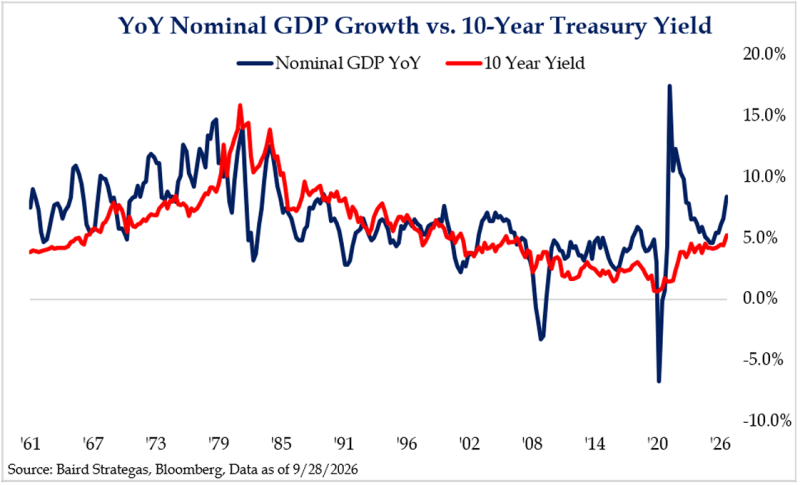
Interestingly, longer term Treasury rates decoupled from oil prices in recent weeks, indicating that there have been other forces driving yields besides inflation. Strong economic growth and surges in business activity likely played a role, because the 10-Year rate has historically been expected to roughly trend with nominal GDP growth (see chart below). That rule of thumb was more accurate in the era before quantitative easing, but recent nominal GDP growth estimates near 8% still imply that rates could have room to keep rising. Of course, the flip side of the coin is that GDP growth could have room to come down to where rates are. We do not expect a recession in the near term, but a slowdown from these high growth rates would not be surprising.
Source: Strategas Research Partners LLC
Other factors that could explain rising yields are the ongoing concern over our government’s mounting fiscal woes, foreign banks divesting our debt, and the massive increase in corporate debt issuance tied to the artificial intelligence (AI) boom. Even though corporate issuances are typically targeting a different audience than Treasury issuances, the scale of the debt being issued could crowd out Treasury demand to some extent.
The scale and speed of the AI infrastructure buildout has been nothing short of extraordinary, and it could outpace prior booms like railroads and telecommunication if capital expenditures continue as projected. Investment from hyperscalers (the largest cloud computing companies that own data centers) is projected to exceed $1 trillion in 2027 and continue growing in future years. The spending has also flowed into “old economy” sectors like industrials, materials, and utilities, and it has been a major force driving economic growth. As shown below, data center construction has skyrocketed in recent years while other private commercial construction has decreased.

Source: Strategas Research Partners LLC
AI’s widening influence on the economy raises the stakes of its need to “succeed”, and the bar for success is quite high because of how much capital has been committed. A notable risk on the horizon is the degree of off-balance sheet financing by major corporations that depends on a rapid acceleration of AI demand. Our markets are heavily levered to the need for widespread adoption, and cash flow generation must grow significantly within the next few years for these contracts to be fulfilled (which could very well be the case).
A wrinkle in the plans of hyperscalers is that data center construction has increasingly become a hot button political issue for voters due to environmental, affordability, and quality-of-life concerns. While the concerns are bipartisan, it is more likely that Democrats would be the party to propose constraints on data center construction and AI adoption if they gain control in the midterm elections. The odds of a Democratic sweep have been increasing in recent weeks, and that trend could continue if oil prices and rates remain elevated or climb further. Our markets have historically been capable of performing well under all combinations of political leadership, but a shakeup in power, especially in gubernatorial races, could take some wind out of the sails of the AI buildout that has been plowing forward unabated the last few years.
While strong earnings have led to impressive returns for equity investors, the average consumer does not feel much better off than they did before the AI boom. As shown in the chart below, labor compensation as a percentage of national income has been falling recently and over the course of decades while corporate profits have been growing. Additionally, the Consumer Sentiment Index is near all-time lows, housing remains unaffordable with 30-year mortgage rates exceeding 7%, and sticky inflation has led to stagnant real wage growth. At some point there could be widespread balking at AI development if it does not actually lead to better economic outcomes for everyday workers.

Source: J.P.Morgan Asset Management
Investment Allocation
Our general approach to equity investing in this environment continues to prioritize quality and diversification. We believe it is worth having measured exposure to the mega trends driving markets like the AI buildout, but there can also be value in a broader portfolio of fundamentally sound companies. The market started the year by broadening beyond the largest AI names, but as of September 30th over half of the S&P 500 constituents are below their 200-day moving average, and market concentration is back near all time highs. Because high concentration has become the status quo, investors might be lulled into forgetting the risk it presents if the stocks at the top are threatened.
The international space is quite interesting in an era of increasing deglobalization. There are plenty of companies abroad with attractive earnings growth expectations, reasonable valuations, and increasingly accommodative corporate governance policies. They can also benefit if the US Dollar keeps losing power over time.
On the fixed income side, we do believe that rates have room to move higher, and that even if they come back down from these levels we will stay in a structurally higher-rate environment than we were in the quantitative easing era. Bond volatility is likely to persist, which is why we have been keeping our duration exposure lower than the benchmark.
Because of the risks in traditional markets and higher stock-bond correlations, this environment continues to make the case for a sleeve of alternative assets that can offer uncorrelated returns when added to a diversified portfolio.
Material discussed is meant for general/informational purposes only and it is not to be construed as tax, legal, or investment advice. Although the information has been gathered from sources believed to be reliable, please note that individual situations can vary therefore, the information should be relied upon when coordinated with individual professional advice. Past performance is no guarantee of future results. Diversification does not ensure against loss. The opinions and forecasts expressed are those of the author, and may not actually come to pass. This information is subject to change at any time, based on market and other conditions.


Third Quarter 2026 Commentary
By Daniel McGarvey, CFA on behalf of Stonebridge Financial Group advisors
The stock market has kept pushing higher in recent months, with the S&P 500 returning 2.3% in the third quarter and 12.8% year-to-date. Economic indicators have also been strong, as evidenced by real GDP (gross domestic product) growth tracking near 5%, an unemployment rate of 4.1%, and benign credit conditions. The more concerning story has been the rapid rise in interest rates and the ensuing bond selloff. The 10-Year Treasury Rate increased from 4.44% on June 30th to 5.29% on September 30th, leading the Bloomberg US Aggregate Bond Index to fall -3.5% over that time and -2.9% year-to-date.
One factor contributing to climbing yields was the Federal Open Market Committee’s decision in September to raise the Federal Funds target by 25 basis points to the 3.75-4% range. It is unclear whether this is a minor adjustment or the beginning of a rate hike cycle, especially because Fed Chair Kevin Warsh is not keen on forward guidance, but as of September 30th futures markets are pricing in one more hike this year and another three next year. We doubt whether that much hiking will be necessary, but the outlook is uncertain since Fed policy depends so heavily on the inflationary effects of continued conflict in Iran.
Interestingly, longer term Treasury rates decoupled from oil prices in recent weeks, indicating that there have been other forces driving yields besides inflation. Strong economic growth and surges in business activity likely played a role, because the 10-Year rate has historically been expected to roughly trend with nominal GDP growth (see chart below). That rule of thumb was more accurate in the era before quantitative easing, but recent nominal GDP growth estimates near 8% still imply that rates could have room to keep rising. Of course, the flip side of the coin is that GDP growth could have room to come down to where rates are. We do not expect a recession in the near term, but a slowdown from these high growth rates would not be surprising.
Source: Strategas Research Partners LLC
Other factors that could explain rising yields are the ongoing concern over our government’s mounting fiscal woes, foreign banks divesting our debt, and the massive increase in corporate debt issuance tied to the artificial intelligence (AI) boom. Even though corporate issuances are typically targeting a different audience than Treasury issuances, the scale of the debt being issued could crowd out Treasury demand to some extent.
The scale and speed of the AI infrastructure buildout has been nothing short of extraordinary, and it could outpace prior booms like railroads and telecommunication if capital expenditures continue as projected. Investment from hyperscalers (the largest cloud computing companies that own data centers) is projected to exceed $1 trillion in 2027 and continue growing in future years. The spending has also flowed into “old economy” sectors like industrials, materials, and utilities, and it has been a major force driving economic growth. As shown below, data center construction has skyrocketed in recent years while other private commercial construction has decreased.
Source: Strategas Research Partners LLC
AI’s widening influence on the economy raises the stakes of its need to “succeed”, and the bar for success is quite high because of how much capital has been committed. A notable risk on the horizon is the degree of off-balance sheet financing by major corporations that depends on a rapid acceleration of AI demand. Our markets are heavily levered to the need for widespread adoption, and cash flow generation must grow significantly within the next few years for these contracts to be fulfilled (which could very well be the case).
A wrinkle in the plans of hyperscalers is that data center construction has increasingly become a hot button political issue for voters due to environmental, affordability, and quality-of-life concerns. While the concerns are bipartisan, it is more likely that Democrats would be the party to propose constraints on data center construction and AI adoption if they gain control in the midterm elections. The odds of a Democratic sweep have been increasing in recent weeks, and that trend could continue if oil prices and rates remain elevated or climb further. Our markets have historically been capable of performing well under all combinations of political leadership, but a shakeup in power, especially in gubernatorial races, could take some wind out of the sails of the AI buildout that has been plowing forward unabated the last few years.
While strong earnings have led to impressive returns for equity investors, the average consumer does not feel much better off than they did before the AI boom. As shown in the chart below, labor compensation as a percentage of national income has been falling recently and over the course of decades while corporate profits have been growing. Additionally, the Consumer Sentiment Index is near all-time lows, housing remains unaffordable with 30-year mortgage rates exceeding 7%, and sticky inflation has led to stagnant real wage growth. At some point there could be widespread balking at AI development if it does not actually lead to better economic outcomes for everyday workers.
Source: J.P.Morgan Asset Management
Investment Allocation
Our general approach to equity investing in this environment continues to prioritize quality and diversification. We believe it is worth having measured exposure to the mega trends driving markets like the AI buildout, but there can also be value in a broader portfolio of fundamentally sound companies. The market started the year by broadening beyond the largest AI names, but as of September 30th over half of the S&P 500 constituents are below their 200-day moving average, and market concentration is back near all time highs. Because high concentration has become the status quo, investors might be lulled into forgetting the risk it presents if the stocks at the top are threatened.
The international space is quite interesting in an era of increasing deglobalization. There are plenty of companies abroad with attractive earnings growth expectations, reasonable valuations, and increasingly accommodative corporate governance policies. They can also benefit if the US Dollar keeps losing power over time.
On the fixed income side, we do believe that rates have room to move higher, and that even if they come back down from these levels we will stay in a structurally higher-rate environment than we were in the quantitative easing era. Bond volatility is likely to persist, which is why we have been keeping our duration exposure lower than the benchmark.
Because of the risks in traditional markets and higher stock-bond correlations, this environment continues to make the case for a sleeve of alternative assets that can offer uncorrelated returns when added to a diversified portfolio.
Material discussed is meant for general/informational purposes only and it is not to be construed as tax, legal, or investment advice. Although the information has been gathered from sources believed to be reliable, please note that individual situations can vary therefore, the information should be relied upon when coordinated with individual professional advice. Past performance is no guarantee of future results. Diversification does not ensure against loss. The opinions and forecasts expressed are those of the author, and may not actually come to pass. This information is subject to change at any time, based on market and other conditions.
Stonebridge Financial Group
Get Expert Financial Guidance Now.
Ready to take control of your financial future? Contact Stonebridge Financial Group today for a personalized consultation. Let us help you navigate complex financial decisions and build a secure path to your goals.